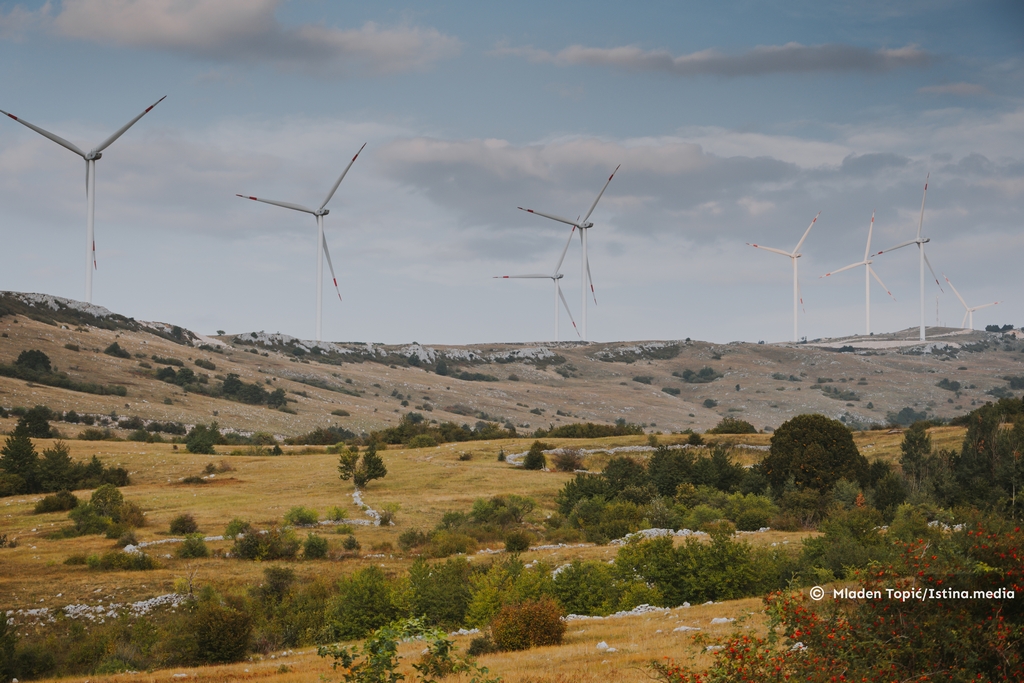
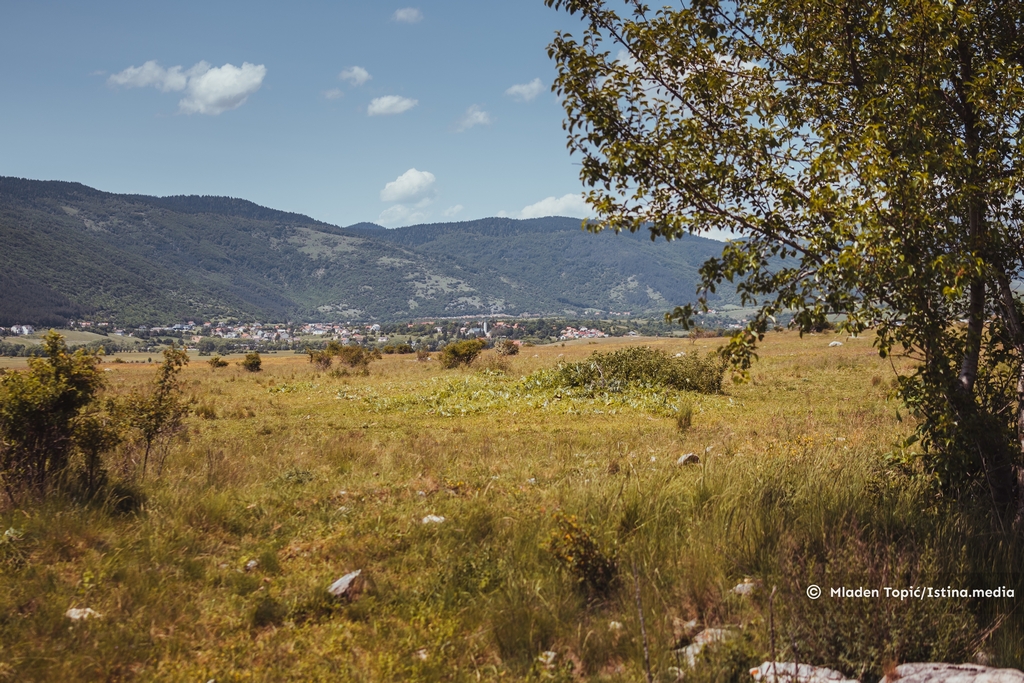
In the territory of the Herzeg-Bosnia County, as many as 28 wind farms are planned, 18 of which are in Tomislavgrad. Beyond the environmental aspect, there is also the question of what will happen to livestock farming, which is just beginning to develop. On the way to Šuica, we came across about two hundred cows — some grazing along the road leading to the Baljci wind farm, others on the hill above Šuica, around a hundred in one spot. This is not a sight commonly seen elsewhere in Herzegovina.
Written by: Kristina Perić / Photos and video: Mladen Topić
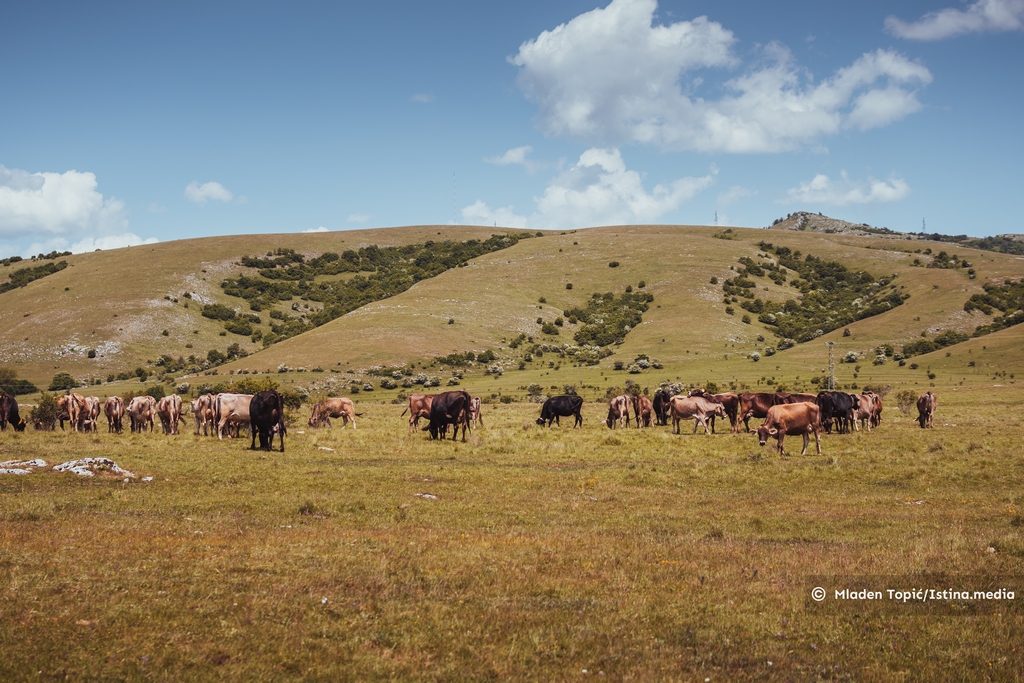
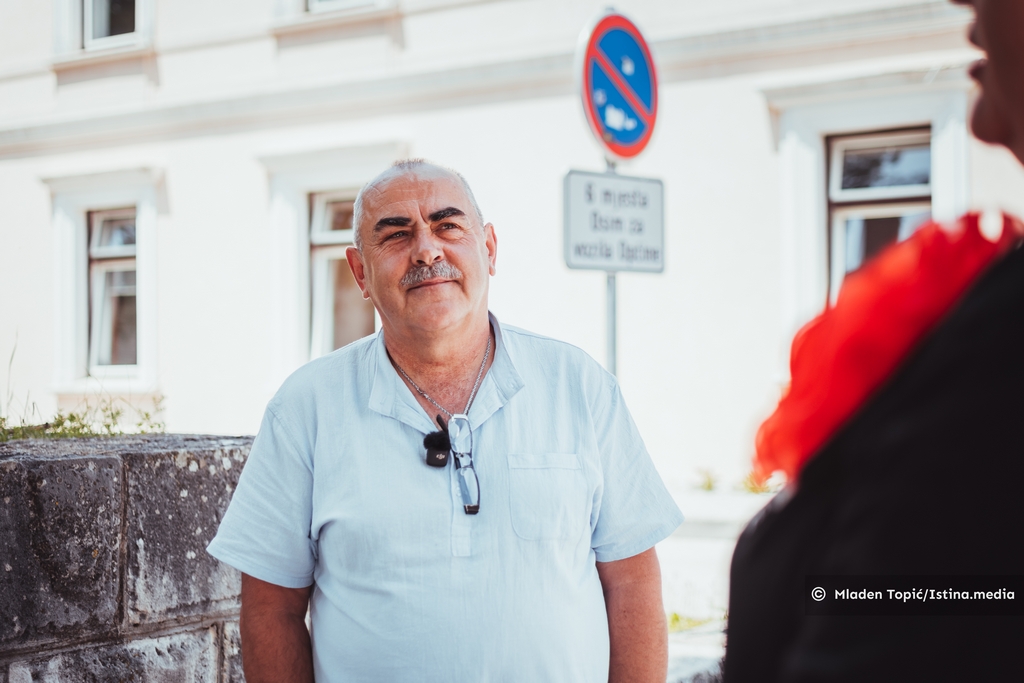
“In recent years, livestock farming in the Šuica area has begun to consolidate a bit. There were years of stagnation, but now we already have several farms with over 200–300 heads of cattle, and if what is in the spatial plan comes to pass, then only the Šuica field itself will remain free of solar panels and wind turbines, while everything else will be covered by them. The two cannot coexist. If we want livestock farming and tourism to develop, then we don’t need wind farms and solar panels. Again, I emphasize, we are not against green energy, but it should be done differently — planned carefully, without endangering the local population. Some wind farms are just a kilometer from inhabited houses. The Galečić wind farm being built above the village is less than a kilometer in a straight line from the settlement”, says Šuica resident Stipe Zrno, a retired war veteran.
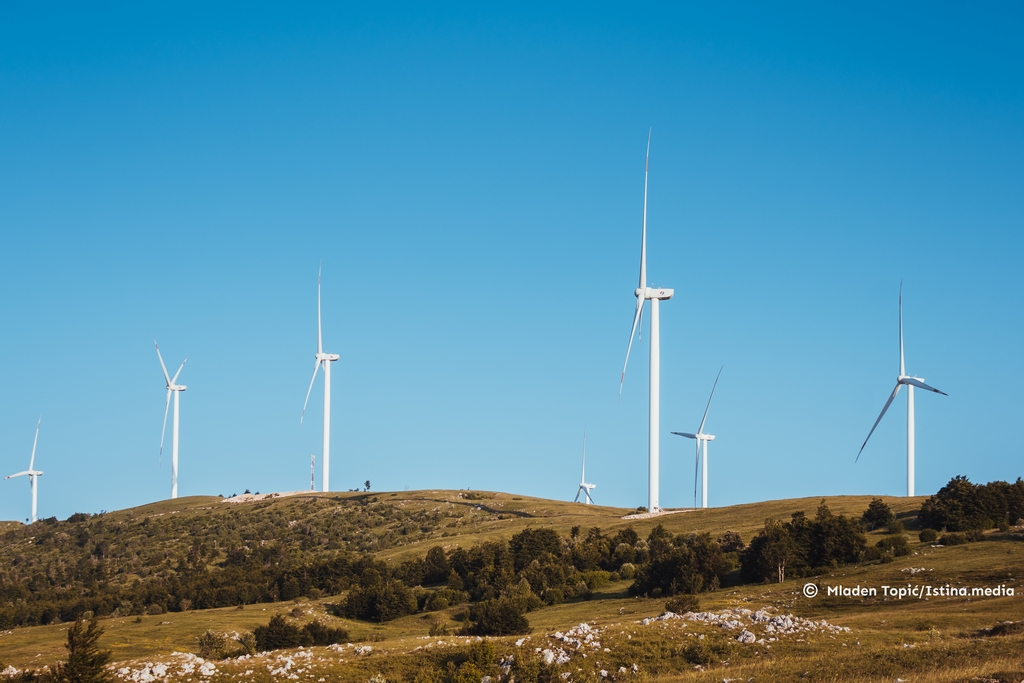
In Šuica, all the surrounding hills would be covered with wind turbines, and all pastures, if the spatial plan is implemented, would be under solar panels.
“This area is known for livestock farming and the timber industry. There has never been any heavy industry here. We are not against green energy, but what is being done is excessive and unplanned. Too much is being crammed in, and the lives of the local population — both those involved in livestock farming and people in Šujica in general — would be greatly changed if this happens”, he adds.
Emigration: A major problem
He tells us that he has spent his life in Šuica, but his children have left in search of work, like many other residents.
“Unfortunately, we have to state the fact that in the last 10–20 years there has been significant emigration. Now there is another large wave of people leaving — entire families, young people are departing. We now have our own authorities; we can no longer blame some foreign power. Unfortunately, the current wave of emigration is even greater than during the worst years for this region. On top of that, our natural resources — the very things this area could live off — are being destroyed: forests are being cleared, arable land is being ruined, tourism is being harmed. This region has great potential for tourism and livestock farming, and work could have been done in these areas to preserve both the people and the environment. While the global trend is food production, here solar panels are being installed on fertile agricultural land, which to me is a total absurdity”, says Zrno.
He tells us that the energy invasion in this region is relatively recent.
“In the last ten or so years, the construction of wind farms and solar parks began. All of this was carried out somewhat in secret; the population was not really aware of what was happening. It was only in recent years, when the heavy earthworks started and the large machines appeared, that we began to understand what was going on. Last year, the spatial plan of our municipality was presented, and that’s when we learned that many of these wind and solar parks are planned not only in the Šuica area but across our entire municipality and county”, Zrno explains.
Young people are leaving, property is being sold off — where is the concession policy of the Herzeg-Bosnia County headed, are residents being consulted, and were public hearings held? We asked our interlocutor.
“Even if public hearings were held, they took place here in the Municipality of Tomislavgrad in the early afternoon, around 1–2 p.m., when attendance is very low. If a public hearing is to be held, I believe it should take place within the local community that is actually affected by these concessions. As it stands, that’s not what happened. I’m telling you, 90 percent of the population was neither involved nor aware of what was going on, and even to this day I still don’t know, because the information is very sparse. We don’t even know who the concessionaires are. One concessionaire, and then it gets resold”, Zrno reiterates.

Bariša Milić from the initiative Let’s Preserve the Duvno Region shares his opinion.
“These spatial plans have been imposed on the citizens; no proper public hearings were held. Even the municipal spatial plans are not aligned with the county spatial plan. We have witnessed that people are unaware that surveys and excavations are being carried out in certain areas”, says Milić.
The local authorities justify such projects by pointing to the inflow of funds, but in reality, it is negligible.
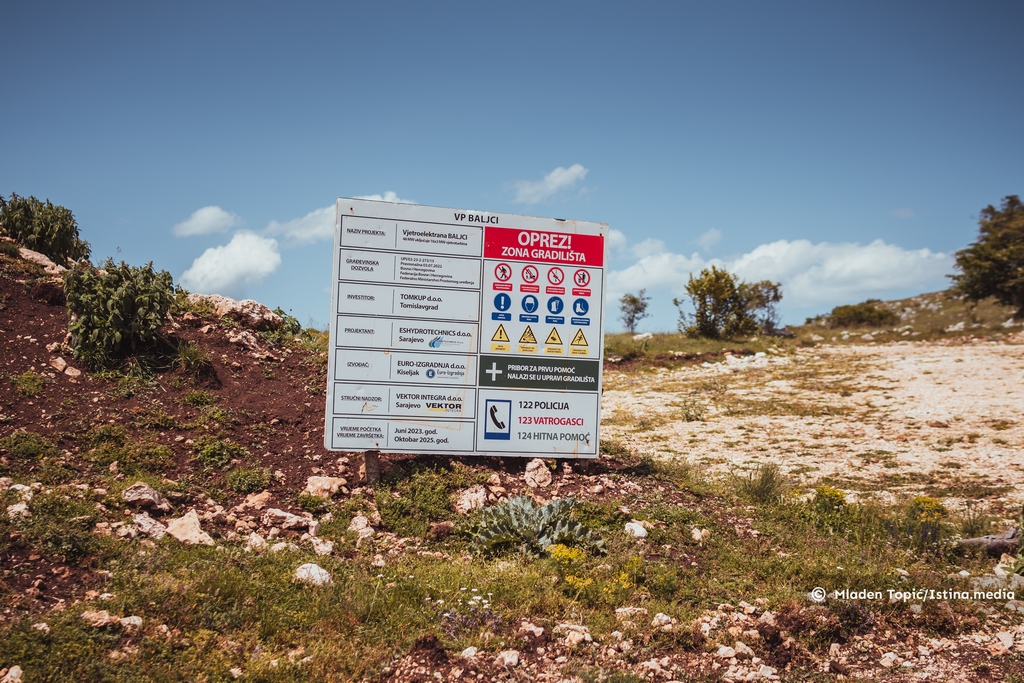
“I’m not fully informed about how much the municipality receives, but as far as I know from the contracts — take, for example, the Baljci wind farm — it did not provide anything for the local community. Some contracts include some form of compensation for the local community. The Baljci wind farm, located above Šuica itself, occupies a very large area including forest land, private and agricultural land, pastures — and nature has been heavily devastated with a lot of work done beyond the scope of the project. The local community gains nothing. And I think that if the municipality is going to sell off our ancestral land, our property, it should at least do so for some real value. Instead, it’s about 2 percent — we have information that the municipality receives roughly 2–2.5 percent of the total from these concessions. That’s very, very little, and I believe it’s not worth losing our land and our nature over”, Zrno notes.
Like Professor Stanić from the first part of our story, he particularly warns about Šujica, the lifeline of this region.
“I believe that both the Šuica River and the springs that feed into it are at risk, and these are significant water sources for the entire area. They provide water supply for the residents of Tomislavgrad, Šuica, and all the surrounding settlements,” concludes Zrno, who is also an activist in the initiative Let’s Preserve the Duvno Region.
Regarding the devastation at Baljci and other construction sites, the activists have called on the authorities, but it has yielded no results.
“We sent requests for inspection visits on several occasions. The inspection did come out to the sites, but nothing significant happened afterward. The inspectors are a major problem; they are actually part of this whole issue”, says Milić.
Signing a Petition
Members of this initiative, along with others from similar groups across Herzegovina, recently protested in front of the State Attorney’s Office.
They also signed a petition.
“Because we were concerned, we launched a petition against these projects. Later, the same effort started in Šuica. In the end, we all united and launched our initiative Let’s Preserve the Duvno Region. We saw that people were mobilizing in different parts of BiH for the same cause. The reason is that these projects are being imposed on people — the spatial plans are forced upon us, they are not aligned with higher-level spatial plans, and currently, there is a ban on managing state property. Specifically, in our county and Tomislavgrad, there is no other case where such a large number of projects is planned and imposed through a spatial plan as it is here. In 2007, the Constitutional Court ruled that the Concessions Law in our county was unconstitutional. If we also consider the ban on disposing of state property, it follows that all concessions in this county, and indeed in any other, are essentially illegal”, says young activist Bariša Milić.
Like the two previous interlocutors, he warns about the silence of the local and cantonal authorities, who completely ignore them, noting that the only assistance they have received came from the Aarhus Center in BiH.
“First, we sent inquiries to the institutions, starting with the local government — the Municipality — then to the Herzeg-Bosnia County, and then to institutions and organizations in the Federation. The Municipality of Tomislavgrad refused to provide any information, rejecting our request as an interested citizens’ group. From the County, only one ministry responded, whereas, interestingly, every institution in the Federation replied”, Milić continues, raising the question of what the local community is hiding from them.

And here we are at the end — or rather the beginning — sharing the experiences of the citizens. For a month, we have been sending inquiries to the Ministry of Economy and the Government of the Herzeg-Bosnia County regarding the Stekerovci wind farm in Glamoč, where an entrepreneur from Kosovo was favored in the race for the largest wind farm in the Balkans. The inquiry was completely ignored. On May 21, we referred to the Law on Freedom of Access to Information and requested a response. We also sent a new inquiry.
Questions posed:
- How many wind farms and solar farms are planned in the territory of the Herzeg-Bosnia County?
- Who are the investors of the already built and planned projects?
- Has the inspection visited the sites to assess the devastation caused during road construction for the wind farms, and is their environmental impact known?
- Were proper public hearings conducted regarding both the already implemented projects and those planned?
- Are you aware of the activities of the informal citizens’ group Let’s Preserve the Duvno Region, and have you provided them with the data they requested?
Given our past experience with this government, we do not expect a response. We posed similar questions to the mayor of Tomislavgrad, and by the conclusion of this report, no answer has been received from him either.
All lawsuits that the media have filed to secure the right to a response end in favor of the media — something the authorities in Herzeg-Bosnia County should take note of. Counties and municipalities are not personal inheritances; they are instruments to preserve the region and its interests while respecting the law and the opinions of the residents.
Istina.media (13.6. 2025.)
Read the first part: